So after my 2011 and 2012 reports. Here's my 2013 report about my sales and experience as an indie educational iOS app developer. I hope you can find some valuable information.
For those who read this blog for the first time:I've made such reports since 2011 to share my experience with other indie app developers who want to understand the market (2011 report , 2012 report ). I started creating apps after reading similar blog posts that reported their experience and sales, and I feel that it is my turn to share my experience. I'm a full-time French indie dev, and I started creating apps in 2010 when the iPad was released. I have 2 adorable daughters who are homeschooled, and it was clear that the iPad was going to be successful with my kids, even if - as most of us - I didn't think that the market would grow that way. We've got a lot of educational materials at home, mostly Montessori, and I usually get my ideas from these materials and then add all the magic that touch devices can add to enhance these materials.
If you want to check my apps, you can go to my website : http://lescapadou.com
Overview since 2010
 |
| Cumulative Sales |
So cumulative sales since 2010 are beyond $1.1M. Amazing. I really didn't think sales could be so nice when I released Montessori Crosswords in 2010. Since I released Word Wizard in August 2011, sales have increased about 5-10% per year although I only had 2 apps in 2011 (plus 2 French localizations), and a lot more now (4 apps in English and a lot of localized apps).
The good news is that releasing one quality app per year, some updates and localizations allows to keep and even increase a little bit my revenue. I always feared that the competition (especially big players and funded startups) would "eat" the market. I think that it is partially true, but some facts are helping me: the market is bigger and bigger, and a lot of people - including Apple when it features indie apps devs - help to spread the word about good indie apps. In addition, I've got a very good user base who love my apps and recommends them.
2013 Sales
Compared to 2013, sales have increased by 5%. This is partially due a very good January month (Montessori Numbers was featured during this period) and the good sales of my new app. We can see the same pattern as in 2012 : strong January and February (supposedly due to iPads gifted for Christmas), then sales decreases progressively until back to school where sales restart - I believe it is the same for everybody in the educational apps category.
It's interesting to see that my first 2 apps (Montessori Crosswords and Word Wizard) are still the best sellers. Still the same conclusion as last year: if you've got an app that people love and a good user base, it's a recipe for success. But don't forget to update your apps so that they stay alive. For example, Montessori Crosswords has not been updated since more than 1 year and I believe it is partially why sales are going down. I don't know exactly why Montessori Numbers has not performed better. My new app, Writing Wizard, has been very well received and I think it will be my best seller next year.
I've got a lot of bulk education purchases so if you check the rank of my apps in 2013 you may not have a correct relation between revenue and rank, because educational purchases are not taken into account for the rank of the app.
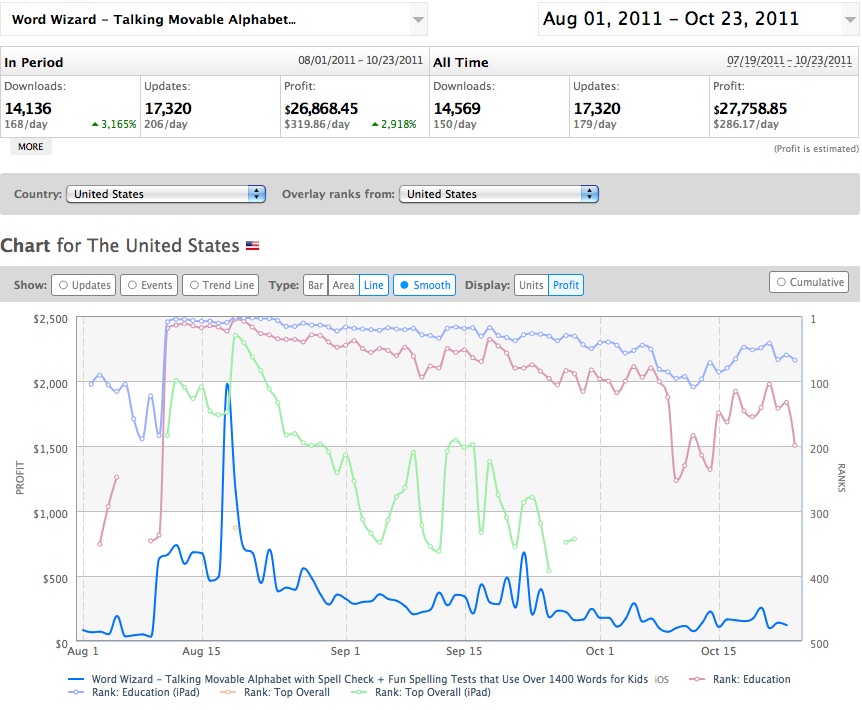
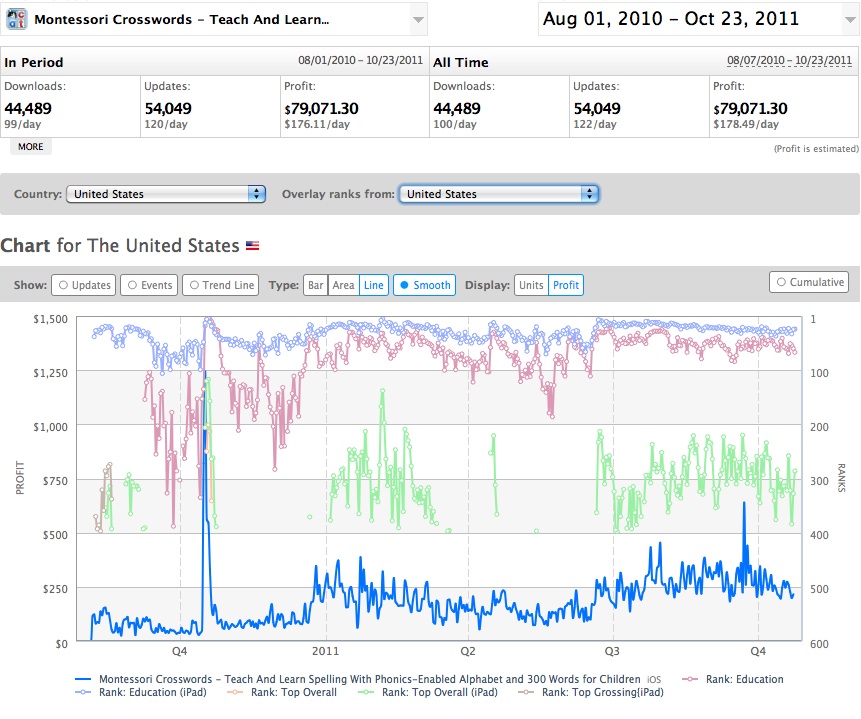
So I've made the figure above for the US market and computed sales without educational purchases to try to compare the 2012 and 2013 market. However, drawing any conclusion is difficult because ranks are really different year to year. I would say that the market is bigger -no surprise - since 2013 average ranking is really lower and it still make 66% of 2012 sales (and we all know that most of the money is in the top of the charts)

Countries
When you see these numbers, you understand why the US market is so important (52% of sales, and with other English-speaking countries, it represents 70% of sales). Localizations, especially in France and Sweden, were worth the efforts especially because, compared to creating a new app, it does not take a lot of time and money to localize an app. Note that I don't mean it's trivial to do a localization - localization of educational apps are usually not trivial especially for apps helping kids to learn how to read or write (Math is more universal and easier to localize - I should do more Math apps…)
School Purchases
Another interesting figure is the last column that represents the educational purchases made by schools. It is just a little bit better than in 2011, but I believe this market is really bigger this year. However, it is the same as in the "parents" market : so many more good apps are available now. Anyway, I really like these purchases because it means that my apps are good educational apps. Note that I don't do discounts for volume purchases (except if somebody asked to do it because they don't have enough budget) because I think 3$ is really cheap. I believe the discount exists for more expensive apps.
I release one polished app every year, and in 2013 I decided to enter a very crowded market : apps that help kids to trace letters. The tracing feature I've added to Montessori Numbers for Christmas 2012 was very well received - people were happy and Apple featured the update - so I decided to do an app based on the same tracing engine with new fun features. After analyzing the market, I found that there was no apps that do everything well. Some apps were very nice and fun (e.g. LetterSchool) but lacked from settings to customize the app to suit every child's needs as well as reporting features which are important for parents and teachers. Some apps did have more features but were not fun enough to keep kids motivated.
•"Fantastic, customizable tracing practice with fun rewards." 5 Stars - Common Sense Media
•"Writing Wizard is the best letter tracing app on iPad" AppoLearning.com
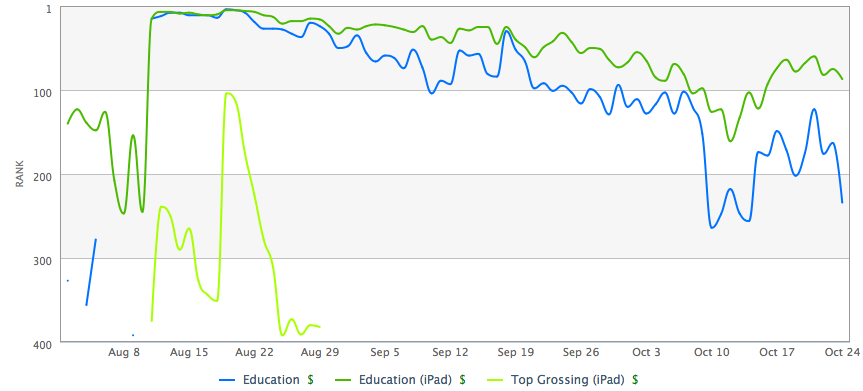
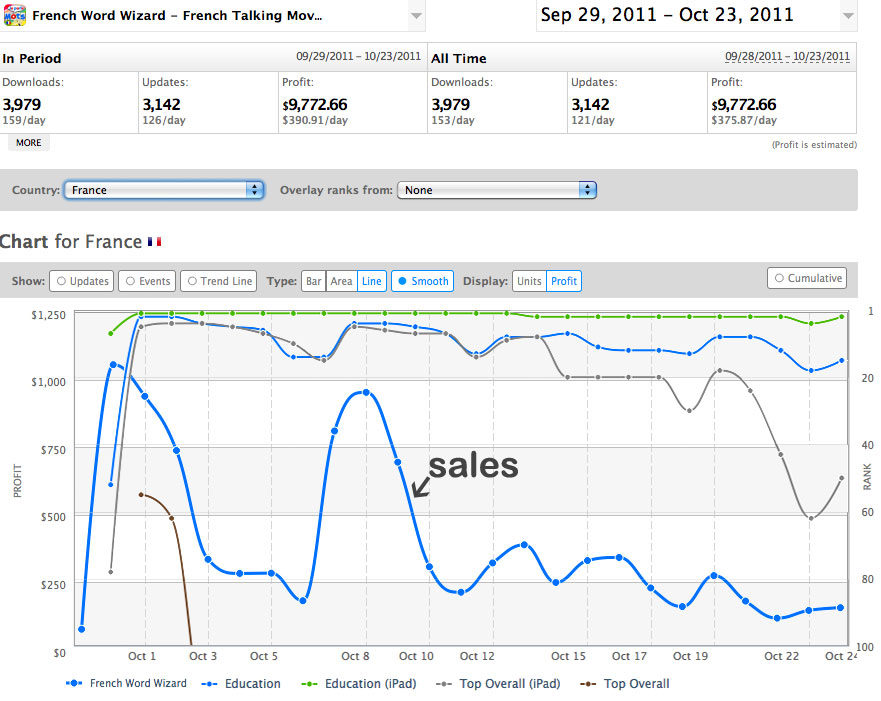
However, sales were good but not fantastic at launch - maybe owing to the fact that a lot of people already have tracing apps and it is more difficult to sell this kind of app, or because it was released too early. As usual, as soon as the app was no longer featured (or less visible), sales began to decrease. Everybody was loving the app and I knew that all I needed was to spread the word a little more. So I decided to set the app free for 1 or 2 days with the help of MomsWithApps AppFriday. I also contacted all bloggers I know, and mid-September there was 60K free downloads in 2 days which pushed the app in the top 30 paid education in the following weeks as you can see in the graph below.
You see the spikes in the graph ? It is educational purchases made by schools... So, again, don't make easy correlation between rank and sales because educational purchases are not taken into account for the ranking.
This week I release an update with a new pre-writing activities section, iPhone support (and some Christmas stickers!) to keep the app alive and hopefully get some visibility. We will see if it helps to boost sales once again. It is also localized in 5 European languages but in most of these countries, kids learn cursive so I don't think it will be a hit in these countries, but I needed to do it because an international cursive version - based on the same engine - will be released next year.
Localization
Android
Android sales are not very good compared to iOS. Most people report that iOS sales are 5 times better, and it's almost the same for me. I've got only one app Montessori Words which has been ported by a friend of mine (it is Montessori Crosswords without the crosswords feature ) that is rated 5 stars on Google Play but revenue are about 40$ a day (25$ on google play, 15$ on Amazon…). Note that the app ranking in US education is around 110 and the app price is $2.99, and that there is a free/lite version to try the app.
I receive more and more mails from people asking me if my app are on Android. So it surely means that the Android educational market will continue to grow, but I don't have enough time to port my Android apps and I prefer to concentrate on iOS. Perhaps I should use a cross-platform framework (e.g. Unity) for my next app so I can release easily on several platforms - but I really like Xcode and objective-c !
Pricing Strategy
All my apps are $2.99. It seems the sweet spot for me. I tried to raise the price of Word Wizard to $4.99 for 2 months. Revenue were a little bit better at the beginning but after one month sales were lower, and I set the price back to $2.99. Perhaps I should try $3.99...
Free with non-consumable In-App purchase (IAP) is an interesting option. It allows people to test the app and buy it if they like it. I wanted to do it for my new App (Writing Wizard) but eventually I didn't do it because I want to be able to set it free sometimes to promote it, and also because schools can't buy IAP. Perhaps a good alternative is to create two apps: one free with IAP and one paid (but I don't know if Apple is still OK with this). Most of big publishers don't use IAP (Disney, Nickelodeon, Toca Boca) but I think it may change in the future and they are doing some experiment (like Disney Princess). Endless Reader (the follow-up to EndLess Alphabet) is free with IAP and performing very well (others examples performing well are Learn With Homer and Agnitus). If you look at the top grossing educational charts you will see that it is mixed between paid and free with IAPs apps.
An interesting experience was how Originator's Endless Alphabet was marketed. It was all about pricing. They released this excellent app as a free app for several months, then moved to $4.99 (or more, it is now $5.99). This way, they did get a huge user base and when they moved to paid, they were directly in the top 10 paid education. Note that it works only if you have a very very good app (so that people talk about it) and you are promoted in a way or another (in their case a lot of featuring on the App Store).
Another interesting company is Motion Math which try several models : free+ IAP, paid + IAP to get more levels, and pro versions without IAP for schools.
Some apps (Reading Rainbow, Agnitus) that are performing well are using a subscription model (user pay every month automatically). However I personally don't really like this model even if it seems very profitable. It looks OK if you add contents every month but it is not the case for all these apps as far as I know.
It also seems that prices are a little bit more expensive that previous years (Toca Boca apps are $2.99, Originators' apps are $4.99)
2013 App Store Changes
The big change this year is the new Kids category on the App Store. Now it is the main place where parents go to find apps for their kids. Before it was the Education category but "Kids" is more explicit and offers filtering by age. Note that the Education category link on the App Store main page has been replaced by the Kids category link which helps a lot to push this new category.
My apps were not in the Kids category at the beginning because I didn't realize it was so important. Actually I was afraid losing all the good reviews on the App Store by releasing updates - an update was needed to be in the new kids category, but when you release an update you loose all your ratings and reviews. Anyway, it was a huge mistake and now all my apps are in the Kids category (and some were featured in a special Montessori section, and it was very good for sales).
2013 Kids Apps Market
The "pure" educational market is not yet invaded by big publishers ("pure" means that the app is targeted to learn something in Common Core State Standard…). Most of them (Disney, Nickelodeon, Toca Boca,..) are doing games but do not focus on "pure" education app - they have some educational apps but it is not their main goal. I believe it is simply because there is more money in games. On the other hand, big publishers are now releasing a lot of apps (check the front page of the Kids category) and they are always featured on the App Store. So it means a little bit less visibility for indie apps, but Apple still cares about small developers creating good apps, and some of us are regularly featured.
But there are of course more and more "pure" educational apps that are better than ever. Indies, small publishers or funded startups are publishing great apps (Originator's Endless Alphabet/Reader, Artgig's Mystery Math Town, Tinybop's Human Body, Learn With Homer, Agnitus,…) So now if you want to enter the market, you really need to create a great app or you will be invisible !
Marketing & my Strategy
Nothing has really changed compared to what I wrote in my 2012 report. So You should read what I wrote in my 2012 report if you're interested in what you can do to market your app (icon, keywords, blog reviews, PR , ads,…)
Also you can now check a great list of review site ordered by traffic at http://www.pappasappar.se/review-sites/
Being Featured
A lot of people have questions about how an app is being featured on the App Store. I believe the answer is simply that there is an editorial team who choose apps they like. So the idea is just to let them know that your app exists. If you've got a contact at Apple, it's easier of course. But I imagine that they also regularly check blogs to know what's going on - so do your marketing and you will see if you did release a good app...
 |
| 2013 Sales |
 |
| 2013 sales by products |
It's interesting to see that my first 2 apps (Montessori Crosswords and Word Wizard) are still the best sellers. Still the same conclusion as last year: if you've got an app that people love and a good user base, it's a recipe for success. But don't forget to update your apps so that they stay alive. For example, Montessori Crosswords has not been updated since more than 1 year and I believe it is partially why sales are going down. I don't know exactly why Montessori Numbers has not performed better. My new app, Writing Wizard, has been very well received and I think it will be my best seller next year.
 |
| Montessori Crosswords US sales and ranks in 2012 and 2013 |
I've got a lot of bulk education purchases so if you check the rank of my apps in 2013 you may not have a correct relation between revenue and rank, because educational purchases are not taken into account for the rank of the app.
So I've made the figure above for the US market and computed sales without educational purchases to try to compare the 2012 and 2013 market. However, drawing any conclusion is difficult because ranks are really different year to year. I would say that the market is bigger -no surprise - since 2013 average ranking is really lower and it still make 66% of 2012 sales (and we all know that most of the money is in the top of the charts)

Countries
When you see these numbers, you understand why the US market is so important (52% of sales, and with other English-speaking countries, it represents 70% of sales). Localizations, especially in France and Sweden, were worth the efforts especially because, compared to creating a new app, it does not take a lot of time and money to localize an app. Note that I don't mean it's trivial to do a localization - localization of educational apps are usually not trivial especially for apps helping kids to learn how to read or write (Math is more universal and easier to localize - I should do more Math apps…)
School Purchases
Another interesting figure is the last column that represents the educational purchases made by schools. It is just a little bit better than in 2011, but I believe this market is really bigger this year. However, it is the same as in the "parents" market : so many more good apps are available now. Anyway, I really like these purchases because it means that my apps are good educational apps. Note that I don't do discounts for volume purchases (except if somebody asked to do it because they don't have enough budget) because I think 3$ is really cheap. I believe the discount exists for more expensive apps.
My New Apps in 2013
As usual, I did have a very optimist roadmap and I couldn't do all I wanted. I wanted to do a new app for back to school, updating Montessori Crosswords and release a new app for Christmas. I only released Writing Wizard and made some localizations (as previous years actually…).
After 6 month of hard work and many many tests with kids, Writing Wizard was released early August and was featured on the US/AUS/UK App Store in the Education category. Reviews were really great - I think it is the best reviews I've got for an app. For example:
•"Writing Wizard is the best letter tracing app on iPad" AppoLearning.com
 |
Writing Wizard worldwide sales and US education ranking |
You see the spikes in the graph ? It is educational purchases made by schools... So, again, don't make easy correlation between rank and sales because educational purchases are not taken into account for the ranking.
This week I release an update with a new pre-writing activities section, iPhone support (and some Christmas stickers!) to keep the app alive and hopefully get some visibility. We will see if it helps to boost sales once again. It is also localized in 5 European languages but in most of these countries, kids learn cursive so I don't think it will be a hit in these countries, but I needed to do it because an international cursive version - based on the same engine - will be released next year.
Writing Wizard 2.0 prewriting activities demo
I have localized Word Wizard in Dutch and Montessori Numbers in Swedish. It usually took one week and a little bit of money to localize an app. It is usually profitable but the problem is always the same: visibility. It is not easy to market an app in a language you don't speak. Dutch Word Wizard was featured in the Dutch App Store and sales were pretty good but now it only sells a few units a day. It is the same issue than in the German market (I did the German localization last year). If you don't have a very good user base or do very good marketing, it is difficult to enter a local market (in addition it is difficult to evaluate the quality of the app even if you ask native people to test it). Swedish Word Wizard sells very well and so I believed it was a good thing to localize the numbers app in Swedish (especially because there are also people who help localize the app for free and a blog, pappasappar.se, that helps spread the word about good apps for kids). It is not a big hit but it is profitable.
Android
Android sales are not very good compared to iOS. Most people report that iOS sales are 5 times better, and it's almost the same for me. I've got only one app Montessori Words which has been ported by a friend of mine (it is Montessori Crosswords without the crosswords feature ) that is rated 5 stars on Google Play but revenue are about 40$ a day (25$ on google play, 15$ on Amazon…). Note that the app ranking in US education is around 110 and the app price is $2.99, and that there is a free/lite version to try the app.
I receive more and more mails from people asking me if my app are on Android. So it surely means that the Android educational market will continue to grow, but I don't have enough time to port my Android apps and I prefer to concentrate on iOS. Perhaps I should use a cross-platform framework (e.g. Unity) for my next app so I can release easily on several platforms - but I really like Xcode and objective-c !
Pricing Strategy
All my apps are $2.99. It seems the sweet spot for me. I tried to raise the price of Word Wizard to $4.99 for 2 months. Revenue were a little bit better at the beginning but after one month sales were lower, and I set the price back to $2.99. Perhaps I should try $3.99...
Free with non-consumable In-App purchase (IAP) is an interesting option. It allows people to test the app and buy it if they like it. I wanted to do it for my new App (Writing Wizard) but eventually I didn't do it because I want to be able to set it free sometimes to promote it, and also because schools can't buy IAP. Perhaps a good alternative is to create two apps: one free with IAP and one paid (but I don't know if Apple is still OK with this). Most of big publishers don't use IAP (Disney, Nickelodeon, Toca Boca) but I think it may change in the future and they are doing some experiment (like Disney Princess). Endless Reader (the follow-up to EndLess Alphabet) is free with IAP and performing very well (others examples performing well are Learn With Homer and Agnitus). If you look at the top grossing educational charts you will see that it is mixed between paid and free with IAPs apps.
An interesting experience was how Originator's Endless Alphabet was marketed. It was all about pricing. They released this excellent app as a free app for several months, then moved to $4.99 (or more, it is now $5.99). This way, they did get a huge user base and when they moved to paid, they were directly in the top 10 paid education. Note that it works only if you have a very very good app (so that people talk about it) and you are promoted in a way or another (in their case a lot of featuring on the App Store).
Another interesting company is Motion Math which try several models : free+ IAP, paid + IAP to get more levels, and pro versions without IAP for schools.
Some apps (Reading Rainbow, Agnitus) that are performing well are using a subscription model (user pay every month automatically). However I personally don't really like this model even if it seems very profitable. It looks OK if you add contents every month but it is not the case for all these apps as far as I know.
It also seems that prices are a little bit more expensive that previous years (Toca Boca apps are $2.99, Originators' apps are $4.99)
2013 App Store Changes
The big change this year is the new Kids category on the App Store. Now it is the main place where parents go to find apps for their kids. Before it was the Education category but "Kids" is more explicit and offers filtering by age. Note that the Education category link on the App Store main page has been replaced by the Kids category link which helps a lot to push this new category.
My apps were not in the Kids category at the beginning because I didn't realize it was so important. Actually I was afraid losing all the good reviews on the App Store by releasing updates - an update was needed to be in the new kids category, but when you release an update you loose all your ratings and reviews. Anyway, it was a huge mistake and now all my apps are in the Kids category (and some were featured in a special Montessori section, and it was very good for sales).
2013 Kids Apps Market
The "pure" educational market is not yet invaded by big publishers ("pure" means that the app is targeted to learn something in Common Core State Standard…). Most of them (Disney, Nickelodeon, Toca Boca,..) are doing games but do not focus on "pure" education app - they have some educational apps but it is not their main goal. I believe it is simply because there is more money in games. On the other hand, big publishers are now releasing a lot of apps (check the front page of the Kids category) and they are always featured on the App Store. So it means a little bit less visibility for indie apps, but Apple still cares about small developers creating good apps, and some of us are regularly featured.
But there are of course more and more "pure" educational apps that are better than ever. Indies, small publishers or funded startups are publishing great apps (Originator's Endless Alphabet/Reader, Artgig's Mystery Math Town, Tinybop's Human Body, Learn With Homer, Agnitus,…) So now if you want to enter the market, you really need to create a great app or you will be invisible !
Marketing & my Strategy
Nothing has really changed compared to what I wrote in my 2012 report. So You should read what I wrote in my 2012 report if you're interested in what you can do to market your app (icon, keywords, blog reviews, PR , ads,…)
Also you can now check a great list of review site ordered by traffic at http://www.pappasappar.se/review-sites/
Being Featured
A lot of people have questions about how an app is being featured on the App Store. I believe the answer is simply that there is an editorial team who choose apps they like. So the idea is just to let them know that your app exists. If you've got a contact at Apple, it's easier of course. But I imagine that they also regularly check blogs to know what's going on - so do your marketing and you will see if you did release a good app...
European Kids App Store is not updated as often as in the US. So it's strange but it may be more difficult to be featured. I released a French Cursive Writing Wizard app two weeks ago, and even if I've got some contacts at Apple France/Europe and it is a pretty unique app with really great reviews, it has not been featured (yet?) whereas Writing Wizard was featured as soon as it was released in the US. I believe that releasing an international app (localized in main European languages) may really help to be featured because most apps are shared across Europe in the kids category. EDIT: it is now featured on the main page of the French App Store - sometimes you just has to wait a little bit (or send another email to your contact!)
Final Words
So I hope that 2014 will as good as 2013. My cousin is going to work with me part time (we will share royalties on an app that he will develop) so perhaps L'Escapadou will release 2 new apps next year.
See you next year and have a wonderful end of year !
Note: All figures are coming from appfigures.com , a very good tool to analyse your sales…which would be perfect if they could add a button to exclude educational sales in their figures.